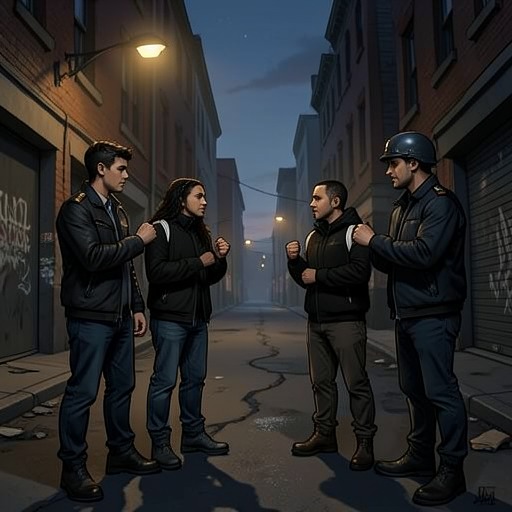
Tony interrupts the duel beneath the overpass
West Side StoryTony interrupts the duel beneath the overpass when a fight between Diesel and Bernardo is already underway, placing himself between the combatants and calling on both gangs to stop. He says neither side has a good reason to fight, but his attempt to halt the violence does not restore order: Bernardo rejects his offered hand, strikes and taunts him, and the gathering turns from an agreed fistfight into a lethal knife confrontation that kills Riff and Bernardo.
From public tension to a negotiated fight
The confrontation grows out of hostility that has already threatened to erupt in public. At the Municipal Community Center dance, the Sharks gather behind Bernardo while the Jets form up behind Riff, Action, and Tony. Murray recognizes that the situation may become a fight and tries to draw the crowd’s attention; when the police arrive, the gangs circle their girls and obey Officer Krupke’s order to dance. The forced circles and the music briefly impose a shared routine, but they do not dissolve the antagonism between the groups.
Later, Bernardo accepts the Jets’ proposal for a contest and tells them to say when. At the appointed meeting beneath the overpass, he prepares to fight, checking that the knife is in his pocket before announcing that he is ready. Riff proposes that Bernardo and Diesel meet in the center and shake hands before starting. Bernardo refuses the gesture: he says that he hates the Jets too much to drink with them, or to shake their hands. Instead, he advances with his fists raised. Riff accepts the refusal and signals Diesel to face him. The agreement is thus reduced to a fight between the two men, without the conciliatory ritual Riff had requested.
The duel before Tony arrives
Diesel and Bernardo begin with their fists. Diesel is heavier, but he is wary of Bernardo’s reputation as a powerful street fighter. Their opening exchanges establish the physical and tactical character of the contest: Bernardo steps back from Diesel’s first left, counters with his own, and evades a later attack; Diesel uses a feint and avoids a punch that only grazes his ear. Bernardo, expecting to knock Diesel out rather than work his body, keeps his attention on landing a decisive blow. Diesel tries to exploit the high guard he expects this approach to demand.
Bernardo lands a short left against Diesel’s shoulder, and Diesel answers with a left to Bernardo’s ribs. Bernardo twists into the counter, reducing its force, but still catches Diesel on the lip; it begins to swell. The exchange encourages Bernardo, who knows Diesel can endure a beating and takes confidence from having marked him. He circles, varying punches, feints, and evasions. The narration compares fighting to dancing: both depend on learned steps and rhythms, and Bernardo plans to change direction in the hope that the shift will unsettle Diesel and expose him to a final blow. The contest has a pattern, but it is also poised to turn on a single opening.
Tony’s intervention and its failure
A shout interrupts the rhythm. Tony arrives breathing heavily and stands between Diesel and Bernardo. He tells everyone to stop and tries to prevent the two fighters from striking again. Riff demands an explanation, angry that Tony has entered the confrontation, while Bernardo mocks him as a man who has finally found the courage to fight his own battles. Tony laughs along with the taunt and offers Bernardo his hand, redirecting the encounter from personal provocation toward the reason for the duel.
Tony tells Bernardo that a good reason to fight would make courage unnecessary, but that neither side has such a reason. Bernardo brushes the offered hand away and shoves Tony, sending him into the dust. He then insists on his own name and declares that after tonight he will be addressed as Mr. Bernardo. Rather than letting Tony’s appeal end the confrontation, Bernardo makes Tony himself its next target. Riff helps Tony up and signals the Jets not to retaliate, reminding Bernardo that the agreed contest is a fair fight between him and Diesel. Bernardo answers by striking Tony lightly across the face and telling Diesel to wait: he intends to use Tony as a warm-up. Riff pushes Tony behind him and orders Bernardo to stop.
The reversal is immediate and consequential. Tony’s intervention had offered a reason to abandon the fight; Bernardo’s refusal turns that intervention into a fresh humiliation and provocation. Riff attempts to hold the group to its agreement, but his effort to protect Tony places him in the middle of a crisis that has already outgrown the original contest. The fair-fight arrangement remains something Riff invokes, not a restraint the antagonists can reliably maintain.
From interruption to fatal violence
The two leaders close in with knives, circling and feinting. Their experience makes the danger plain: such a fight may end with one blow, and rarely requires more than two or three. Around them, the crowd presses closer. Diesel and Action momentarily loosen their hold on Tony, giving him the chance to break free. Riff shouts for him to retreat and makes a broad gesture with his arm; in that brief opening, Bernardo lunges and drives his blade into Riff’s chest, just below the heart. Riff dies before he reaches the ground.
Tony takes the knife from Riff’s limp hand and charges Bernardo before Bernardo can set himself to defend. The blade enters Bernardo’s side, and he collapses mortally wounded. A police siren sounds; a patrol car stops above the group, and its beam sweeps the side of the highway as the Jets and Sharks scatter. The episode therefore does not end with Tony’s intervention restoring peace or even preserving the negotiated duel. It ends with both leaders dead and the crowd dispersed by the arrival of the police.
Significance
The interruption exposes the gulf between an attempt to stop violence and the ability to control it. Tony names the absence of a good reason to fight, while the duel’s terms and the men’s actions show how pride, hostility, and the demand to answer an insult keep supplying new occasions for violence. The hand offered by Tony and the handshake proposed by Riff are both rejected; gestures that might have recognized an opponent as a person cannot hold against the rivalry surrounding them.
The scene also turns the duel’s supposed rules against their purpose. Riff tries to preserve the agreed match between Diesel and Bernardo and keep the Jets from reacting to Bernardo’s treatment of Tony. But as the contest shifts from fists to knives, that limited framework collapses. Tony stops one fight only to become the focus of another, and Riff’s intervention to manage the conflict leaves him exposed to Bernardo’s attack. The deaths of Riff and Bernardo make the failure of the intervention irreversible, while the returning police and fleeing gangs leave the underlying hostility unresolved.